How Change Really Happens: Beyond the Metrics

In this last newsletter of the year, we’ve taken a deep dive into the impact of our work with clients to investigate what really makes change happen. Impact is something anyone working in the business of change cares about. Yet, as a sector we tend to apply a supremacist culture lens in how we define impact - scale, quantity, proof of effort, focus on outputs and often based on short term metrics. This looks good on paper but in reality isn’t really connected to change that matters. At New Ways we define impact as the felt, sustained shift in how people lead, relate, make decisions and live their values. It’s evidence of transformation, a visible shift in courage, honesty, integrity, and more alignment on the things that matter most to people and the mission.
Over the last couple of years we have been interviewing our clients after working with us to explore what impact our work together has had on them and their organisations. We recently did a piece of analysis on those conversations to reveal with clarity the key levers of change. We thought we’d share some snippets with our community.
Insight 1: Change starts when leaders do personal work first
We’re just beginning a new programme supporting leaders across a sector wanting to embed JEDI into their leadership and practice, and the reason this work has come about was from the reflection of a team member working with a leader we were supporting about the new found ease in working and talking together on topics of justice and equity. Our analysis really confirmed this - the deepest shifts began when leaders stopped trying to “fix” and turned inward - noticing how their upbringing, identity, assumptions, fears and relationship to power shaped their behaviour. Once they slowed down enough to look at themselves honestly, they led differently: with more clarity, less reactivity and far more courage. And that internal shift became the catalyst for cultural and organisational change.
What we’re noticing

What does the world need of its leaders?
There’s an important distinction between what leaders ask for vs. what the world needs from them. It’s interesting to reflect that most leadership development starts with the question: “What do leaders want?” And often those answers might be around more confidence, better skills, or tools to manage teams. While that might be useful, it’s far too small for the times we’re in.
As Peter Hawkins, the systems constellation guru says, leadership development shouldn’t just respond to what leaders think they need, but to what the world needs of its leaders. That framing sits at the heart of our work.
A glimpse of this in practice
Listen to our latest Story of Impact with the CEO of Eating Better, who shared that her biggest shift wasn’t gaining new tools, it was realising how her own patterns were shaping the culture around her. When she changed how she showed up, her team’s focus and energy changed too. That’s the kind of leadership growth our times require: not more techniques, but deeper self-awareness, honesty and alignment.
We were at Locality’s Member Convention last month, where I chaired a session. After a year of supporting their leadership team to embed racial justice and equity internally and externally, it was powerful to see that work fully alive in the room. It showed up in who was present, in the confidence and clarity of what was being said, and in the depth and honesty of the conversations. One delegate came up to me afterwards and said how different the event felt to a couple of years back, and that kind of felt change is something to celebrate, Well done!
what we’re practising
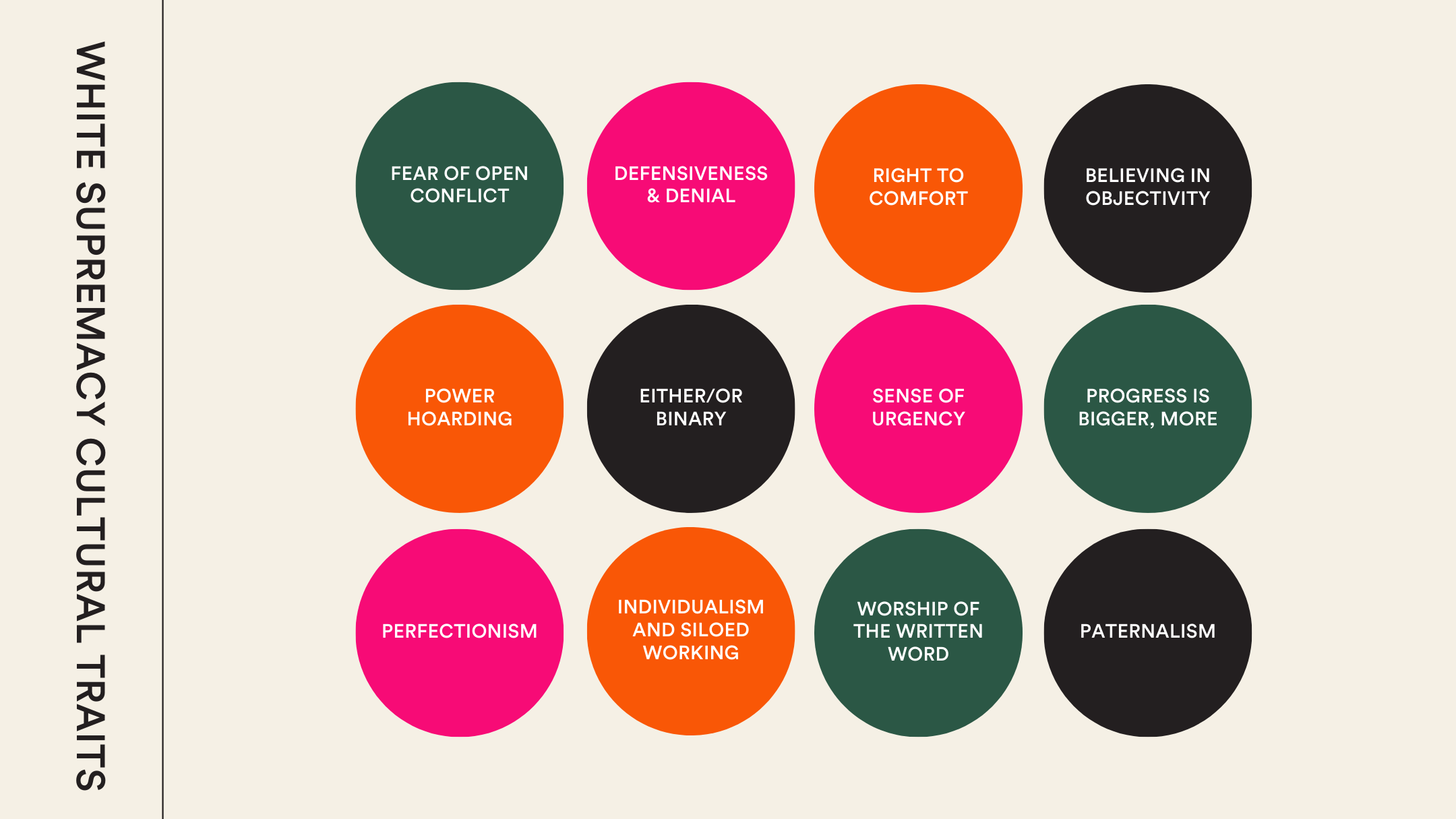
What does it take to unlearn white supremacy culture?
If you've been with us for a while, you'll already know about our Beyond White Supremacy Unlearning Programme, with the next cohort beginning in March 2026. But you might not have a clear sense of what actually happens inside the programme - or what this unlearning work feels like in practice. So this January, we’re offering two free 60-minute online taster sessions to give you a real experience of the work.
We talk a lot about dismantling harmful systems. But what about the traits and behaviours we carry - often unconsciously - that keep those systems alive?
Look at the twelve traits listed above - these are the core traits of white supremacy culture that we'll be exploring deeply in the programme. Do you recognise any of them in how you work, make decisions, relate, or respond under pressure?
Our taster sessions offer a space to explore what we mean by white supremacy culture and why interrogating these traits matters so urgently right now. You’ll leave with a clearer sense of how these patterns live and breathe both around and within us - and why understanding them is essential for anyone who wants to bring about systemic change without replicating what’s broken.
At its heart, this work is for people who care about their legacy. People who want to create ways of living, working, leading, and creating that are genuinely equitable. People who feel a responsibility to make good use of the self - whether that’s through unlearning supremacy culture to become a radical example of freedom from it, or by shifting from paralysis to action, from powerlessness to change.
Ultimately, this is a journey about bravery: not only talking about what could be better, but practising it.
If this sounds like you, we'd love for you to join us.
When: Click here to register for 9th January session & here for 30th January session
Where: On Zoom
your festive generosity

If our work has supported you or your organisation this year, we’d love your help reaching others who might need it in 2026.
One of the strongest messages from this year’s Stories of Impact is that change spreads through relationships. In a year when LinkedIn has been unpredictable, and visibility is harder to maintain, our community has become even more important as guardians, advocates and champions of this work.
You and your trust, the conversations you have with people in your network, your willingness to bring us into rooms we can’t reach on our own, all helps enormously.
We’re especially looking to support organisations who want help with:
Refreshing or realigning values so they become lived practice
Strengthening team dynamics and ways of working
Leadership alignment during change, growth or complexity
Leadership development aligned to the themes described in our newsletter
A warm introduction makes all the difference.
If you have someone in mind, you can reply with a name, email address, or a link to an organisation's website, send a short email introducing us, or if you would rather have a conversation with us first, reach out and we'll set up a time to chat. Whichever option you choose, we’ll take it forward with care.
Thank you for being part of this community, and for helping New Ways continue doing work rooted in justice, courage and connection.
Wishing you all a joyful, restorative festive season, and we look forward to connecting in 2026.