Insights from our Stories of impact
For the past two years, we’ve been listening deeply to leaders and teams after working together to better understand what actually makes change happen inside organisations. In this piece we revisit these Stories of Impact to get a better understanding of this. What we found was both clarifying and hopeful, and has helped to sharpen our focus for 2026.
challenging a superficial view of “impact”
Impact is often defined through a supremacy-culture lens: scale, pace, numbers, activity, optics. It measures proof of effort rather than evidence of transformation. It rewards what is visible and counts, what is quick and looks good.
But meaningful change, the kind that shifts culture and shapes the leadership we need and want, is slower, relational, uncomfortable and often initially invisible, or at least subtle. It is found in behaviour, courage, alignment and values in practice. It can be grand gestures but it’s often found in micro-moments that snowball to create longer lasting impact and change.
We define impact as the visible and sustained shift in how people lead, relate, make decisions and live their values. And our review revealed some clear impact patterns in this work of building cultures of integrity, care, equity and accountability:
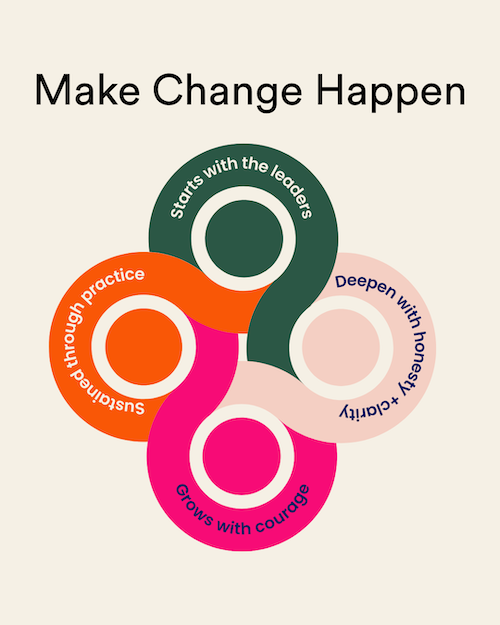
Insight 1: change starts when leaders do the personal work first
The deepest shifts began when leaders stopped trying to “fix” and turned inward. They began noticing how their upbringing, assumptions, fears and relationship to power shapes their leadership behaviour, and recognised how avoidance, defensiveness and silence were echoing across their teams because they were present in themselves.
Once leaders slowed down enough to look at themselves honestly, they led with more clarity, less reactivity and far more courage. That internal shift became the catalyst for relational and then cultural change.
“The self-reflection is necessary to realise when you change, your organisation changes.”
“My personal leadership skills have developed significantly - massively - because of this work.”
insight 2: transformation starts with revealing what’s been driving the culture
Long before we arrive, every organisation is already shaped by unspoken forces: avoidance, defensiveness, self-protection, silence, assumptions about alignment, invisible power dynamics and inherited leadership norms built around fixing, certainty and emotional detachment. Even overconfidence - “we already know or do this” - often masks fear or the desire to look competent.
These cultural forces shape how people speak, make decisions, respond to tension and interpret risk. People feel them every day, but rarely name them.
The work began to deepen the moment these underlying dynamics were made visible. What had been intangible became something everyone could finally see and talk about. Naming these forces didn’t resolve everything, but it changed the starting conditions, and that shift altered the trajectory of the work. People spoke about the relief of finally being able to articulate what they had long sensed but couldn’t explain.
“We were worried that if we said something, it would be the wrong thing and we would get judged for it. You have to be open. It might be quite hard to hear and not be defensive about it.”
“There was a huge difference between people about how bold we really were… some felt we were already doing enough, others felt we hadn’t even started.
insight 3: clarity creates courage
Across almost every story, leaders described a moment when things suddenly became clearer, not because the work became easier, but because they finally had the language, frameworks and shared understanding to name what was happening.
And critically, leaders realised that clarity isn’t the same as certainty, and that distinction mattered. Clarity gave them the grounding to act with courage, even when the path ahead wasn’t guaranteed. And with that came new permission to act.
Leaders named power dynamics they had previously avoided.
Teams surfaced tensions without collapsing.
Boards understood their role differently and took responsibility for it.
People took ownership for repair and truth-telling.
Leaders stepped into their authority with less fear and more integrity.
insight 4: honesty reshapes how people work together
Across the stories, people described a shift in how they spoke to one another. Leaders talked about feeling less guarded, less worried about “saying the wrong thing,” and more willing to name what was actually happening.
Teams were having challenging conversations with more ease. Misunderstandings surfaced earlier. People asked better questions. There was less second-guessing or holding back of perspectives, or concerns. Leaders described moving away from the polished, “say the right thing” mode they had learned in previous workplaces, and instead were more real and open.
One of our proud moments was receiving an email from team member of colour who shared ‘I can feel the difference in the leadership team since working with you’
insight 5: discomfort becomes a teacher, not a threat
One of the strongest things our clients play back to us is a shift in relationship to discomfort. Leaders described realising that discomfort is not a signal to retreat, but evidence that something meaningful is happening and that breaking through the right to comfort is when real change becomes possible.
“I realised discomfort is part of the work.”
“I stopped avoiding difficult conversations.”
“I leaned into the tension instead of shutting down.”
New Ways approach was often named as part of what made discomfort safe enough for people to stay in the room. By refusing to rush people out of difficult emotions, and by modelling calm, grounded presence, we helped them turn discomfort into curiosity.
This shift from avoidance to openness to action became one of the strongest predictors of long-term cultural change.
insight 6: change sticks when people practise, not when they learn
Leaders made it clear that the work didn’t change them because they understood it - it changed them because they practised it. They talked about “thinking, and then living it”: trying new behaviours in real conversations, not waiting until they felt fully confident.
People practised naming tension, pausing instead of reacting, listening with intention, setting boundaries, repairing harm, naming racial dynamics, and staying curious in moments of discomfort. They practised speaking honestly while staying connected - speaking more plainly with their teams, and being more direct with their boards about responsibility and alignment..
Others talked about the shift from “fixing” to “learning and listening,” and how repeatedly trying these different behaviours slowly replaced older habits. This repetition, rather than intellectual or theoretical understanding is what made change happen.
This is also why we role-model practice in the room: slowing down, naming what we see, staying present when it’s uncomfortable, and showing leaders how to navigate the moment without shutting down or smoothing over. And it’s why our work happens over time, not as a one-off intervention.
our commitment for 2026
The organisations we partner with are not just trying to “improve”. They are trying to become places where people lead with integrity, act with courage, and build cultures capable of holding truth, tension and complexity without breaking.
We are entering a political and social moment defined by fear, division, pressure and speed. The instinct to retreat, perform or polish the surface will only grow stronger, unless leaders are supported to grow themselves.
Organisations cannot meet this moment with inherited leadership models, one-off training, performative values or structures that avoid conflict. They need leaders who can bring their full selves, who can name what is real, who can act from alignment rather than anxiety or fear. They need cultures that can withstand pressure, hold difference and repair with integrity.
If the insights above resonate with your organisation, there are three core areas of work you can partner with us on next year.
1. Leadership Development Rooted in Personal and Relational Growth
We’ve seen how the most meaningful organisational change begins when leaders do their own work first. We want to do more to support CEOs, directors, trustees and emerging leaders to understand how their patterns, identity, fears and assumptions shape their leadership - and how these quietly ripple through their teams.
2. Cultural Diagnostics That Reveal What’s Really Driving Your Organisation
We’ve seen how invisible set of norms and habits stagnate and block change. We want to do more diagnostic work surfaces what is actually happening beneath the surface, giving leaders and teams the clarity they need to address the real issues rather than the symptoms.
3. Organisational Clarity & Alignment
We want to bring more clarity and momentum to organisations struggling because people are working with different assumptions, different language and different interpretations of what “good” looks like.
This is the future we are shaping with the leaders who are ready for it. Come join us!